
Feed and Linkedin page


What is the difference between welded pipe and seamless pipe?
This is a very common and important question in the field of metal materials. Simply put, a welded pipe is made by coiling and welding steel strip or steel plate, so it has a seam; while a seamless pipe is made by piercing and rolling a solid steel billet, so it has no seam. In the broad category of carbon steel pipe, both welded and seamless types are major subcategories.
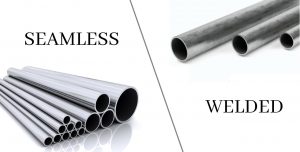
Below is a detailed comparison, explaining the differences from aspects such as manufacturing process, performance, application, and price.
Core Difference: Manufacturing Process
This is the root cause of all other differences.
1. Welded Pipe
Raw Material:Steel strip (coil) or steel plate.
Main Process: The strip/plate is formed into the desired tubular shape (round, square, etc.) by a forming machine, and then the seam is joined using various welding techniques (such as High-Frequency Resistance Welding [often used to produce ERW steel pipe], Submerged Arc Welding, Laser Welding) to form the pipe.
Visible Feature:A weld seam is usually visible on the inner or outer wall of the pipe. For high-precision welded pipes, the seam may be treated to be less obvious, but it can still be detected by non-destructive testing equipment.
2. Seamless Pipe
Raw Material:Solid round steel billet.
Main Process:The hot billet is pierced by a piercer to form a hollow thick-walled shell (hollow bloom), which is then processed into the final pipe size through processes like hot rolling, cold rolling, or cold drawing to create a round seamless pipe.
Visible Feature:The pipe is a single, integral piece with no weld seam whatsoever.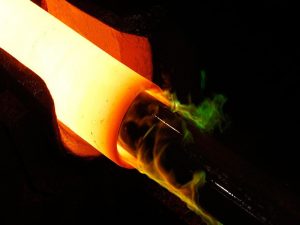
Performance Differences
| Characteristic | Welded steel pipes | Seamless pipes |
| Strength & Pressure Resistance | The weld seam is usually the weak point. Its strength depends on welding quality. Overall pressure rating is generally lower than that of a seamless pipe of the same material and specification. | Uniform strength throughout, with no weak points. Higher pressure resistance. Especially suitable for high-pressure environments. |
| Corrosion Resistance | The microstructure or composition in the weld zone may differ, making the seam and heat-affected zone potentially more susceptible to corrosion in corrosive environments. | Uniform material structure results in more uniform corrosion resistance without the risk of seam corrosion. |
| Wall Thickness Uniformity | High precision in wall thickness control due to the flat material, very uniform. | The piercing and rolling process can lead to slightly poorer wall thickness uniformity, with some deviation possible. |
| Size Range | Extremely wide range of outer diameters and wall thicknesses. Can produce large-diameter, thin-walled pipes (e.g., over 2 meters in diameter) as well as small-diameter pipes. | Limited by piercing technology, difficult to produce very large diameter or extremely thin-walled pipes. More suitable for medium/small diameters and thicker walls. |
| Surface Finish | Usually good, especially for cold-rolled welded pipes. | Hot-rolled seamless pipes have an oxide layer, average finish; cold-drawn seamless pipes have a better finish. |
| Roundness & Straightness | Usually good. | Relatively slightly poorer. |
Application Fields
Welded Pipe:
Low-Pressure Fluid Conveyance: Such as water, gas, air, oil in low-pressure systems (most common use).
Structural Applications:Scaffolding, guardrails, structural supports, furniture, machinery frames.
Large-Diameter Pipeline:Oil & gas transmission pipelines, municipal networks (using submerged arc welded pipe).
Decorative Use:For decorative projects where strength and pressure requirements are not critical.
Seamless Pipe:
High-Pressure, High-Temperature, Critical Environments:Boiler tubes, superheater tubes, hydraulic systems (cylinder tubing), automotive drive shafts.
Pressure Equipment:Pressure piping in petrochemical plants, high-pressure vessels.
Mechanical Parts:Bearing sleeves, precision mechanical components (using cold-drawn precision seamless pipe).
Hazardous Media Conveyance:High-pressure piping for flammable, explosive, or toxic media.
Price & Cost
Welded Pipe:Lower production cost.Raw material (steel strip) is usually cheaper than billets, and production efficiency is high.
Seamless Pipe:Higher production cost.The manufacturing process is more complex, energy-intensive, and yield is relatively lower.
How to Tell Them Apart Simply?
1. Look Inside:Examine the inner wall of the pipe carefully. If you can see a longitudinal line (the weld seam), it’s a welded pipe. If not, it might be seamless or a welded pipe with a very well-finished seam.
2. Check Standards/Marking:Pipes are usually marked or tagged with specifications, standards, and material. The standard code is a key clue:
Common Welded Pipe Standards:GB/T 3091, API 5L, ASTM A53.
Common Seamless Pipe Standards:GB/T 8163, GB/T 6479, API 5CT, ASTM A106.
3. Sound Test (Experiential Method):When suspended and tapped, a seamless pipe typically produces a clearer, longer-ringing sound than a welded pipe, but this requires experience.
Summary
| Aspect | Welded Pipe | Seamless Pipe |
| Core Process | Made by welding, has a seam. | Made by piercing/rolling, no seam. |
| Main Advantages | Low cost, flexible sizes, uniform wall thickness. | High pressure rating, good strength, uniform corrosion resistance. |
| Main Disadvantages | The weld seam is a potential weak point. | Higher cost, slightly poorer wall uniformity, size limitations. |
| Selection Principle | Prioritize cost, for low-pressure, structural, or non-critical pressure applications. | Prioritize safety & performance, for high-pressure, high-temperature, critical, or hazardous applications. |
In short, welded pipe is the preferred choice when cost is a major factor and the application involves low pressure, structural use, or non-critical service. Seamless pipe is a must when safety, pressure capability, and reliability are paramount.Advancements in welding technology (e.g., laser welding) have enabled high-end welded pipes to approach the performance of seamless pipes and replace them in some areas, but the fundamental distinctions remain.
Tel: +86 18202256900 Email: steel@tjdpbd.com


