
Feed and Linkedin page

How many galvanizing methods are there for transforming black steel pipes into galvanized pipes?
Okay, this is a very practical question. Transforming black steel pipes (i.e., ordinary steel pipe without any coating) into galvanized pipes primarily involves the following two mainstream galvanizing methods, along with some supplementary explanations.
Two Mainstream Galvanizing Methods
1. Hot-Dip Galvanizing (HDG)
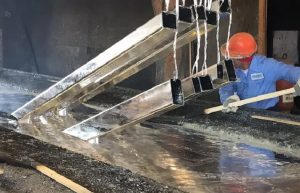
This is the most common and widely used method, especially for applications requiring high corrosion resistance. The term “galvanized pipe” typically refers t “hot-dip galvanized steel pipes“.
Core Principle: The thoroughly cleaned black pipe is immersed in a bath of molten zinc at approximately 450°C, causing the steel substrate to react with the zinc to form a metallurgically bonded alloy coating.
Main Process Flow:
1. Chemical Pre-treatment: Includes degreasing (oil removal), pickling (rust removal), rinsing, and fluxing (applying a flux coating to prevent oxidation).
2. Hot-Dip Galvanizing: The pre-treated black pipe is immersed in the zinc kettle.
3. Post-Galvanizing Treatment: After extraction, the zinc coating thickness and uniformity are controlled either by air-knife wiping (“blow galvanizing”) or by natural drainage (“batch galvanizing”/dip coating), followed by cooling.
4. Post-treatment:May include passivation (e.g., chromating) to enhance resistance to white rust.
Characteristics:
Thick Coating: Strong anti-corrosion capability and long service life.
Good Adhesion:The zinc-iron alloy layer creates a strong bond between the coating and the substrate.
Appearance: The surface may have a spangled pattern or be slightly rough, and may exhibit drip marks (common in batch/dip processes).
Applications: Building structures, water pipes, gas pipes, scaffolding, highway guardrails, etc.
2. Electrogalvanizing (EG)
Pipes produced by this method are often called “electrogalvanized pipes” or “cold-galvanized steel pipes”. Its appearance and principle are completely different from hot-dip galvanizing.
Core Principle: Under an electrical current, electrolysis causes zinc ions to reduce and deposit onto the steel pipe’s surface, forming a zinc coating. This is a physical deposition process and does not involve molten zinc.
Main Process Flow:
1. Chemical Pre-treatment: Similar to HDG, involving cleaning steps like degreasing and pickling.
2. Electroplating: The steel pipe acts as the cathode and is immersed in an electrolyte solution containing zinc ions, while a direct current is applied.
3. Post-treatment: Includes rinsing and passivation (which can yield various colors like iridescent, blue-white, or black).
Characteristics:
Thin Coating:Typically only 5-20 micrometers, offering far inferior corrosion resistance compared to HDG.
Smooth Surface: The coating is uniform, fine, and aesthetically pleasing.
No Alloy Layer:The coating is primarily pure zinc, with weaker adhesion than HDG.
Applications: Mainly used for applications requiring high dimensional accuracy, good appearance, and operating in indoor, dry environments, such as furniture, appliance housings, and small parts. Not recommended for outdoor or humid/corrosive environments.
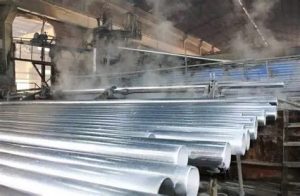
Supplement: Classification by Production Method
Under the broad category of hot-dip galvanizing, based on the form of the steel pipe and the production line, it can be further divided into:
Continuous Hot-Dip Galvanizing: Suitable for coiled welded pipe. The welded pipe passes continuously through the entire galvanizing line, including the zinc kettle. This method is highly efficient and usually employs air-knife wiping (“blow galvanizing”) to precisely control coating thickness, resulting in good surface quality. Commonly found standard-sized galvanized pipes are often produced this way.
Batch Hot-Dip Galvanizing: Suitable for individua steel pipes or pipes cut to length. Batches of pipes are immersed in the zinc kettle using a hoist. This method is more flexible, often uses the dip coating / natural drainage method, and typically results in a thicker coating. It is commonly used for large structural components, thick-walled pipes, or non-standard parts.
Summary Comparison Table
| Characteristic | Hot-Dip Galvanized Steel Pipes | Cold-Galvanized Steel Pipes (Electrogalvanized) |
| Core Process | Immersion in molten zinc, Metallurgical bond | Electrolytic deposition, Physical adhesion |
| Coating Thickness | Thick (Typically 50-200 µm+) | Very Thin (Typically 5-20 µm) |
| Corrosion Life | Long (Decades possible) | Short (Years, depending on environment) |
| Coating Appearance | Spangled, potentially uneven, grayish | Smooth, uniform, various colors possible |
| Coating Adhesion | Strong (Alloy layer present) | Weaker (Pure zinc layer) |
| Cost | Relatively higher | Relatively lower |
| Primary Applications | Outdoor, Heavy-Duty Corrosion Protection (Structures, Piping) | Indoor, Decorative, Precision (Furniture, Appliances) |
| Environmental Aspects | Zinc fumes, waste acid treatment | Challenge of treating heavy metal wastewater |
In simple terms:
If you need a pipe for outdoor, underground, or humid environments (e.g., water pipes, scaffolding, guardrails), you must choose hot-dip galvanized steel pipes.
If you need a pipe for indoor, dry environments where appearance and dimensional precision are the main concerns (e.g., display racks, furniture), cold-galvanized steel pipes can be considered, but you must be aware of their weak rust prevention capability.
Therefore, the primary methods for transforming black steel pipes into galvanized pipes are hot-dip galvanizing and electrogalvanizing. The choice depends on the final application scenario.
Tel: +86 18202256900 Email: steel@tjdpbd.com


