
Feed and Linkedin page



Do you really understand the classification and performance of square tubes?
Process classification
Square and rectangular tubes are classified by production process into: hot rolled seamless rectangular tube, cold drawn seamless square tube, extruded seamless square tube, and welded square tube.
Welded square tube is further divided into:
(a) By process: arc welded square tube, resistance welded square tube (high frequency and low frequency), gas welded square tube, and furnace welded square tube.
(b) By weld seam: straight seam welded square tube and spiral welded square tube.
Material classification
Tubes are divided into ordinary carbon steel square tube and low alloy square tube by material. Common carbon steels include Q195, Q215, Q235, SS400, 20# steel, 45# steel, etc. Low alloy steels include Q355, 16Mn, Q390, St52-3, etc.
Production standard classification
Tubes are categorized by standards into national standard, Japanese standard, British standard, American standard, European standard, and non-standard square tubes.
Section shape classification
Tubes are classified by cross-sectional shape:
(1) Simple cross-section tubes – square tubes and rectangular square tubes.
(2) Complex cross-section tubes – patterned square tubes, open square tubes, corrugated square tubes, and special-shaped square tubes. The common Square And Rectangular Steel Tube falls under the simple cross-section category.
Classification of surface treatments
Based on surface treatment, tubes are divided into hot-dip galvanized rectangular tube, electro-galvanized square tube, oil-coated square tube, pickled square tube, and Black Rectangular Steel Tube (often referring to tubes with a black oxide or untreated mill finish).
Usage classification
Tubes are classified by use: decorative tubes, machine tool equipment tubes, mechanical industry tubes, chemical industry tubes, steel structure tubes, shipbuilding tubes, automobile tubes, beam and column tubes, and special-purpose tubes.
Wall thickness classification
Tubes are classified by wall thickness: extra-thick wall square tube, thick wall square tube, and thin wall square tube.
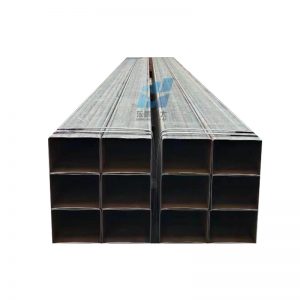
Performance of Square and Rectangular Tubes
1. Plasticity
Plasticity refers to the ability of metal materials to undergo plastic deformation under load without damage.
2. Hardness
Hardness measures the softness or hardness of a metal material. The commonly used method in production is the indentation hardness method, where a geometrically shaped indenter is pressed into the metal surface under a specific load, and the hardness value is determined by the degree of indentation. Common methods include Brinell hardness (HB), Rockwell hardness (HRA, HRB, HRC), and Vickers hardness (HV).
3. Fatigue
The strength, plasticity, and hardness discussed above are mechanical properties of metals under static load. In reality, many mechanical components operate under cyclic loads, leading to fatigue under such conditions.
4. Impact Toughness
Loads acting on machinery at high speeds are called impact loads. The ability of a metal to resist damage under impact loads is called impact toughness.
5. Strength
Strength refers to the ability of a metal material to resist failure (excessive plastic deformation or fracture) under static load. As loads can act in tension, compression, bending, or shear, strength is divided into tensile strength, compressive strength, flexural strength, and shear strength. There is always a certain relationship between various strength measures, with tensile strength being the fundamental index used in practice. This is crucial for applications like structural supports made from Square And Rectangular Steel Tube.
Tel: +86 18202256900 Email: steel@tjdpbd.com


