
Feed and Linkedin page

ASTM A53 vs ASTM A500: How to Choose the Right Steel Pipe for Your Project
Many worldwide customers raise the same question when buying carbon steel pipes from our factory or if they should for construction, fabrication, or industrial use: What’s the difference of ASTM A53 and ASTM A500 and which one is suitable for my application?
They are both popular ASTM standards used for carbon steel products, however, they have different intentions. Selecting the right specification can save the customer from having to incur unnecessary expense, engineering problems, and delays in delivery.
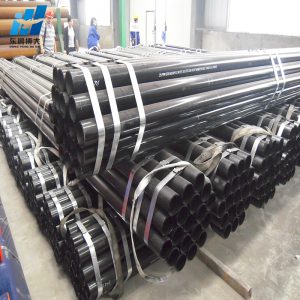
ASTM A53 vs ASTM A500: What Is the Difference? ASTM A53 is a standard specification for black and hot-dipped, zinc-coated, welded, and seamless steel pipe for use in mechanical and pressure applications and also in ordinary uses. ASTM currently recognizes A53/A53M-24 as one of its standards.
In contrast to that, ASTM A500/A500M is a cold-formed welded and seamless carbon steel structural tubing specification. It covers round, square, and rectangular as well as special-section tubing used in buildings, bridges and the like.
This distinction is important for buyers: A53 focuses on pipe service, while A500 focuses on structural performance.
Which One Should Customers Choose?
For projects involving water, air, steam, or other general pipe-service applications, ASTM A53 may be the more appropriate specification, subject to the project design and applicable codes.
For steel structures, columns, beams, trusses, frames, and hollow structural sections (HSS), ASTM A500 is generally the better choice because its scope is specifically focused on structural tubing.
A500 also gives buyers more shape options. In addition to round tubing, it covers square and rectangular sections, making it particularly useful for structural fabrication.
Strength and Cost Considerations
Another key concern for buyers is material efficiency. ASTM A500 structural tubing is available in different grades, allowing engineers to select mechanical properties according to project requirements. For example, commonly supplied A500 Grade B and Grade C tubing has minimum yield strengths of 46,000 psi and 50,000 psi respectively for shaped sections.
However, customers should not select a standard based on strength or price alone. The application, design code, dimensions, grade, wall thickness, welding requirements, and required certifications should all be considered.
How Can Buyers Avoid the Wrong Specification?
Before placing an international steel order, buyers should clearly confirm:
Application and service conditions
Round, square, or rectangular shape
Outside diameter or section dimensions
Wall thickness and length
Required ASTM grade
Welded or seamless manufacturing process
Inspection and test requirements
Mill test certificate and other documentation
Most importantly, ASTM A53 and ASTM A500 should not be treated as automatically interchangeable. The correct choice depends on the engineering requirements of the project.
For buyers abroad, consulting with a reputable steel supplier can streamline the process of choosing specifications and minimize the possibility of being supplied with material that does not meet the requirements of the project. By prioritizing the application and then considering the ASTM standard, buyers will be able to optimize between performance, compliance, availability, and total cost of purchase.
ASTM A53 vs ASTM A500 is not simply a question of which standard is “better”—it is a question of which standard better solves your project requirements.
Tel: +86 18202256900 Email: steel@tjdpbd.com


