
Feed and Linkedin page

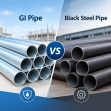
Hot-Dip Galvanized (GI) Pipe vs. Zinc-Aluminum-Magnesium (ZAM) Pipe: What’s the Difference?
This is a very practical and important question. Hot-dip galvanized pipes and Zinc-aluminum-magnesium pipes are two mainstream anti-corrosion steels on the market today, and there are significant differences between them.
Simply put, Zinc-Aluminum-Magnesium pipe can be seen as an “upgraded version” of the hot-dip galvanized pipe, representing a huge leap in corrosion resistance.
Below is a detailed comparison across several key dimensions:
I. Core Summary (Quick Overview)
| Feature | Hot-Dip Galvanized (GI) Pipe | Zinc-Aluminum-Magnesium (ZAM) Pipe |
| Coating Composition | Primarily pure zinc (≥99%) | A ternary alloy of Zinc + Aluminum + Magnesium |
| Corrosion Protection Mechanism | Zinc acts as a sacrificial anode, protecting the steel base by consuming itself | “Barrier Protection” + “Sacrificial Anode Protection” dual mechanism. Magnesium enhances self-healing. |
| Corrosion Resistance | Good | Excellent, typically 5-20 times that of GI, especially at cut edges and scratches. |
| Cut-Edge Protection | Poor. The exposed steel at cuts rusts easily, spreading from the edge. | Excellent. Coating elements actively migrate to the cut edge, forming a protective layer to prevent red rust spread. |
| Appearance | Silver-white, with spangle pattern (regular spangle or minimal spangle) | Silver-gray, more uniform, smooth, and fine-grained. |
| Workability/Formability | Good | Better. The coating is more flexible, offers better scratch resistance, and is less prone to cracking when bent. |
| Cost | Lower. Mature technology, widely used. | Higher. However, the super-long service life can lead to a lower total cost of ownership. |
| Primary Applications | Building structures, scaffolding pipes, guardrails, ordinary conduit, and galvanized welded pipes for general use. | Applications demanding high corrosion resistance: livestock farming, solar mounting structures, automotive frames, cold chain logistics, construction in harsh environments. |
II. Detailed Difference Analysis
1. Coating Chemical Composition & Microstructure
Hot-Dip Galvanized (GI) Pipe:
Coating is ≥99% pure zinc, with possible traces of lead, antimony, etc. This is the standard for most **galvanized welded pipes**.
Its protection relies primarily on the chemical properties of the zinc layer itself.
Zinc-Aluminum-Magnesium (ZAM) Pipe:
The coating is a ternary eutectic alloy. A typical composition is Zn – 11%Al – 3%Mg (varies by manufacturer).
Role of Aluminum (Al): Improves fluidity for a more uniform coating, forms a dense aluminum oxide film (barrier protection), and enhances surface luster.
Role of Magnesium (Mg): This is the key! Magnesium reacts with zinc and aluminum to form a dense layer of protective basic carbonate salts. Crucially, when the coating is damaged, magnesium preferentially migrates to the damaged area, “actively” repairing the protective layer and halting further corrosion.
2. Corrosion Protection Mechanism & Performance
Hot-Dip Galvanized (GI) Pipe: “Sacrificial Anode” Protection.
Zinc is more electrochemically active than iron. When corrosive agents (like water, oxygen) reach the steel base, zinc corrodes instead of iron, protecting the underlying steel. This process continuously consumes the zinc layer until it’s depleted, after which the steel begins to rust. This is a cost-effective solution for products like scaffolding pipes.
Critical Weakness:At cut edges, sheared sections, or scratches, the internal steel is exposed. The limited zinc at the edge offers weak protection, and the exposed steel rusts rapidly, spreading inwards from the edge. This is a common failure point in standard galvanized welded pipes.
Zinc-Aluminum-Magnesium (ZAM) Pipe: “Barrier Protection” + “Enhanced Sacrificial Anode” + “Self-Healing”.
Barrier Protection:The addition of aluminum creates a very dense and stable film of oxides and hydroxides, effectively blocking the ingress of corrosive agents and significantly slowing the corrosion rate.
Enhanced Sacrificial Anode: Zinc and magnesium together provide a powerful and long-lasting cathodic protection effect.
Self-Healing Capacity:This is its most outstanding feature. When the coating is damaged (e.g., cut, scratched), magnesium in the coating actively “flows” to the exposed steel surface, reacting with water and CO₂ in the air to form protective compounds like magnesium hydroxide and carbonate, automatically sealing the damaged area and preventing red rust. This makes it highly resistant to damage during fabrication.
3. Cut-Edge Corrosion Resistance (The Most Critical Difference)
This is where the practical performance difference is most pronounced.
Hot-Dip Galvanized Pipe: After cutting, the steel at the edge has almost no protection and will quickly develop red rust in humid environments, gradually spreading inwards. This is a major concern for scaffolding pipes and other galvanized welded pipes that are frequently cut and assembled on-site.
Zinc-Aluminum-Magnesium Pipe: After cutting, the coating components actively form a protective layer over the cut edge. In standard salt spray tests, ZAM pipe’s cut edges can remain free of red rust for hundreds of hours, whereas GI pipe may show severe red rust in just tens of hours.
4. Appearance & Workability
Appearance:GI pipe typically has a visible spangle pattern (large or small), with relatively lower gloss, which is characteristic of many galvanized welded pipes. ZAM pipe has a uniform, smooth, bright silver-gray appearance, which is more aesthetically pleasing.
Workability: The ZAM coating has stronger adhesion to the steel base and is more flexible. During processes like bending and stamping, the coating is less prone to peeling, powdering, or flaking, and it offers better scratch resistance.
III. How to Choose?
Choose Hot-Dip Galvanized (GI) Pipe when:
It’s for use in ordinary, dry environments (e.g., indoor building structures, conduit, temporary facilities like caffolding pipes).
The project is extremely cost-sensitive and doesn’t require an ultra-long service life (e.g., 10-20 years is sufficient). This applies to many standard galvanized welded pipes for general purposes.
The application involves minimal cutting and fabrication.
Choose Zinc-Aluminum-Magnesium (ZAM) Pipe when:
The environment is highly corrosive: coastal areas, chemical plants, high-humidity regions, areas where de-icing salts are used.
Cut-edge protection is critical: For all applications where cut edges cannot be re-protected, such as solar mounting structures, livestock cages and feeding systems(strong ammonia corrosion), automotive parts, outdoor electrical cabinets. It is superior to traditional galvanized welded pipes in these scenarios.
Ultra-long service life and low maintenance costs are desired: Although the initial investment is higher, its exceptionally long maintenance-free life can significantly reduce the total cost of ownership.
The components require high formability.
Conclusion
Zinc-Aluminum-Magnesium pipe is not meant to completely replace hot-dip galvanized pipe but rather offers a higher-performance alternative. Through its unique ternary alloy coating and self-healing mechanism, especially its revolutionary advantage in cut-edge protection, it addresses the long-standing weakness of GI pipes. If your project demands high durability and reliability, or is situated in a harsh environment, then ZAM pipe is unequivocally the superior choice. However, for cost-effective, general-purpose applications like scaffolding pipes and other galvanized welded pipes used in mild conditions, traditional hot-dip galvanized steel remains a valid and widely used option.
Tel: +86 18202256900 Email: steel@tjdpbd.com


