
Feed and Linkedin page

What is the Application Difference Between Pre-Galvanized and Hot-Dipped Steel Pipes?
This is a highly technical question. While both pre-galvanizing and hot-dipping involve coating steel with molten zinc, the fundamental difference in the order of operations leads to significant variations in product form, performance, and, consequently, their applications.
In simple terms, the core difference is:
Pre-Galvanizing:Zinc coating first, then fabrication. This typically refers to the continuous, high-speed galvanizing of steel coils or strips, which are later formed into pipes or other shapes.
Hot-Dipping:Fabrication first, then zinc coating. This refers to dipping a finished product (like a black steel pipe or structural piece) into a molten zinc bath.
Let’s delve into the specifics of how this affects their application.
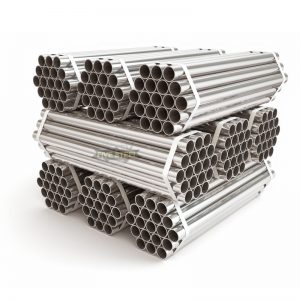
Pre-Galvanized Steel Pipe
1. Process Nature
Also known as “mill galvanized” or “coil coating.” It uses pre-galvanized steel coil as the raw material. This coil is then formed into a pipe shape and welded using a high-frequency electrical current.
2. Primary Application Areas
Electrical Enclosures and Chassis:e.g., computer cases, electrical cabinets, where a uniform and aesthetically pleasing surface is required.
Furniture and Household Goods: Such as metal furniture, filing cabinets, and shelving that need a good surface finish for painting or direct use.
Ventilation Ducts:For HVAC systems, which require a clean, uniform surface.
Low-Pressure Fluid Transport:Used for some indoor, low-pressure water or gas lines.
Internal Components for Automotive and Agricultural Machinery:Where appearance is important but the corrosion environment is not extreme.
3. Application Characteristics
High Surface Quality: The zinc coating is very uniform, smooth, and visually appealing. Coating thickness can be precisely controlled using an “air knife.”
Weld Seam is Uncoated:This is the biggest weakness. The heat from the welding process burns off the zinc layer at the seam, exposing the bare steel base. Although some post-weld treatments can be applied, the corrosion protection at the weld is inherently inferior to a fully dipped pipe.
High Dimensional Accuracy:Made from cold-rolled sheet, these galvanized pipes have very consistent wall thickness and precise dimensions.
Cost-Effective:Highly efficient and lower cost for producing thin-walled, high-volume pipes.
Shape Limitations:Typically only capable of producing pipes with relatively small diameters and thin walls.
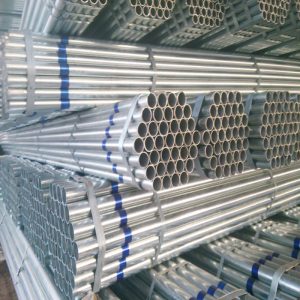
Hot Dipped Galvanized Steel Pipe
1. Process Nature
Often called “post-fabrication galvanizing” or “batch galvanizing.” Fully fabricated black steel pipes are thoroughly cleaned and then completely immersed in a bath of molten zinc.
2. Primary Application Areas
Building Structures:Such as structural frameworks for warehouses, stadiums, and auxiliary bridge structures (e.g., trusses, supports).
Infrastructure:Power transmission towers, highway guardrails, street light poles, communication towers.
Load-Bearing and Outdoor Facilities:Scaffolding, construction formwork.
High-Pressure Fluid Transport:Long-distance pipelines for oil, natural gas, and water (typically large diameter).
Harsh Environments:Chemical plants, coastal areas, and any industrial or agricultural facilities exposed long-term to the elements.
3. Application Characteristics
Full Protection:The entire pipe, including the interior, exterior, and critically, the weld seam, is covered with a continuous zinc layer, providing 360-degree corrosion protection.
Thick Coating, Long Life:The coating is generally much thicker than on a pre-galvanized steel pipe, offering excellent corrosion resistance and a service life that can span decades.
Superior Adhesion:The entire pipe substrate metallurgically bonds with the zinc, creating an extremely strong coating that is highly resistant to mechanical damage.
Relatively Rough Surface:The coating is less uniform than pre-galvanized, often exhibiting drips (icicles) and spangles, making it less aesthetically pleasing.
High Dimensional Flexibility: Can process finished pipes of virtually all sizes, from small to very large diameters and a wide range of wall thicknesses.
Summary Comparison Table
| Feature | Pre-Galvanized Steel Pipe | Hot Dipped Galvanized Steel Pipe |
| Process Order | Galvanize first, fabricate pipe second | Fabricate pipe first, galvanize second |
| Product Form | Typically thin-walled, small diameter pipes | Pipes of various diameters/wall thicknesses, including heavy-duty large pipes |
| Coating Coverage | Weld seam is uncoated, creating a weak point | Full coverage inside, outside, and on weld seam |
| Surface Quality | Smooth, uniform, aesthetically pleasing | Rough, with drips and spangles, less visually appealing |
| Corrosion Resistance | Good (but the weld seam is a liability) | Excellent, especially for harsh environments |
| Mechanical Strength | Thinner coating, weaker adhesion | Thick coating, very strong adhesion, resistant to impact and abrasion |
| Primary Applications | Indoor products where appearance matters | Outdoor/Industrial products where structure & durability are critical |
| (furniture, appliances, ducts) | (structures, pipelines, guardrails, scaffolding) |
Your decision-making path is very clear:
If your application is indoors, requires a good appearance, and is not in a highly corrosive environment, choose a pre-galvanized steel pipe for its cost-effectiveness and visual advantages.
If your application is outdoors or in a harsh environment, and demands maximum corrosion life and structural integrity, then you must choose a hot dipped galvanized steel pipe for its comprehensive, full-coverage protection. All these types of galvanized pipes serve the purpose of protection, but the level and robustness differ significantly.
Tel: +86 18202256900 Email: steel@tjdpbd.com


