
Feed and Linkedin page

Welded Steel Pipe Welding Process: How to Ensure Reliable Quality for Your Project
September 4, 2026
Selecting the appropriate welded steel pipe welding process is essential for international purchasers, to guarantee safety of the pipeline, service life, and project cost control. Different applications employ different welding processes, and if the wrong process is used, it can result in weld defects, dimensional issues, or installation problems.
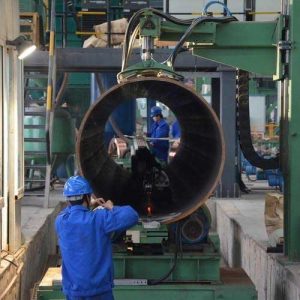
Having a basic understanding of how welded steel pipe is produced can assist buyers in making more informed purchasing decisions, particularly with the escalating demand for steel pipes in oil and gas transportation, water supply, construction, and energy projects.
What Is the Welding Process for Welded Steel Pipe?
Welded steel pipe is typically produced by rolling steel coils or plates into a cylindrical shape and then welding the edges together. The most common production techniques are ERW (Electric Resistance Welding), LSAW (Longitudinal Submerged Arc Welding) and SSAW (Spiral Submerged Arc Welding).
The selection depends on considerations like pipe diameter, wall thickness, material grade, operating pressure, usage and relevant codes.
1. ERW Steel Pipe Welding Process
ERW steel pipe is normally produced from steel coils. After uncoiling, leveling, forming, and edge preparation, the pipe edges are joined using high-frequency electrical resistance welding.
The main advantage of ERW is its efficient and consistent production process, making it suitable for many small- and medium-diameter applications. For buyers requiring stable dimensions, competitive pricing, and high production efficiency, ERW can be an effective option.
2. LSAW Steel Pipe Welding Process
LSAW pipes are processed from steel plate. The plate is formed into a cylinder by JCO, or UOE process, and then submerged arc welded (SAW) along the longitudinal seam.
For large, high-pipe-line pressure (HIP) and high-quality pipe applications, LSAW provides strong control over the manufacturing process and is widely used for water transmission, oil and gas pipelines, and many other infrastructure projects. The procedure typically comprises plate inspection, edge preparation, forming, welding, expanding, dimensional inspection and non-destructive testing.
3. SSAW Steel Pipe Welding Process
SSAW, also known as spiral submerged arc welded pipe, is produced by forming a steel strip into a spiral cylindrical shape and welding the helical seam using submerged arc welding.
This process provides flexibility in producing large-diameter pipes and can be considered for water, structural, piling, and certain pipeline applications.
How Is Weld Quality Controlled?
For overseas buyers, welding technology alone is not enough. Quality inspection and traceability are equally important.
According with the project specification and standard, manufacturers may conduct visual examination, dimensional examination, hydrostatic testing, ultrasonic testing (UT), radiographic testing (RT), and so on. For instance, API Specification 5L specifies requirements for one line pipe, including manufacture, inspection, testing, marking, and traceability.
Before placing an order, buyers should confirm:
Required pipe diameter and wall thickness
Steel grade and applicable standard
ERW, LSAW, or SSAW manufacturing process
Welding and inspection requirements
Hydrostatic and NDT requirements
Mill Test Certificate (MTC) and material traceability
Surface treatment, coating, and end finishing
Inspection by a third party when required
Choosing the Right Welding Process for Your Project
There is no single type of welding that will be best for every use. The best answer should be decided by the project specification rather than the cost.
A good steel pipe manufacturer can help you determine the best manufacturing method that satisfy your needs based on your size, pressure, material, industry, and country of end user.
Buyers of welded steel pipe who import can mitigate risk associated with supply and project if they obtain their material from a vendor manufacturer that offers controlled welding procedures, comprehensive inspection documentation and material certificates that are fully traceable and production that is consistent.
Conclusion: The choice of a appropriate welded steel pipe welding process is an crucial technique to safe, long life and cost effective pipeline operation. International buyers can eliminate typical quality problems and make sure they get products since defining technical requirements and checking welding quality pre-shipment is also a common practice.
Tel: +86 18202256900 Email: steel@tjdpbd.com


